The Moon’s Terminator: A Moving Border of Light
The Moon’s day–night boundary makes craters, ridges, and valleys easier to see. Learn why it shifts, when to look, and how to troubleshoot a view that seems flat or hard to find.
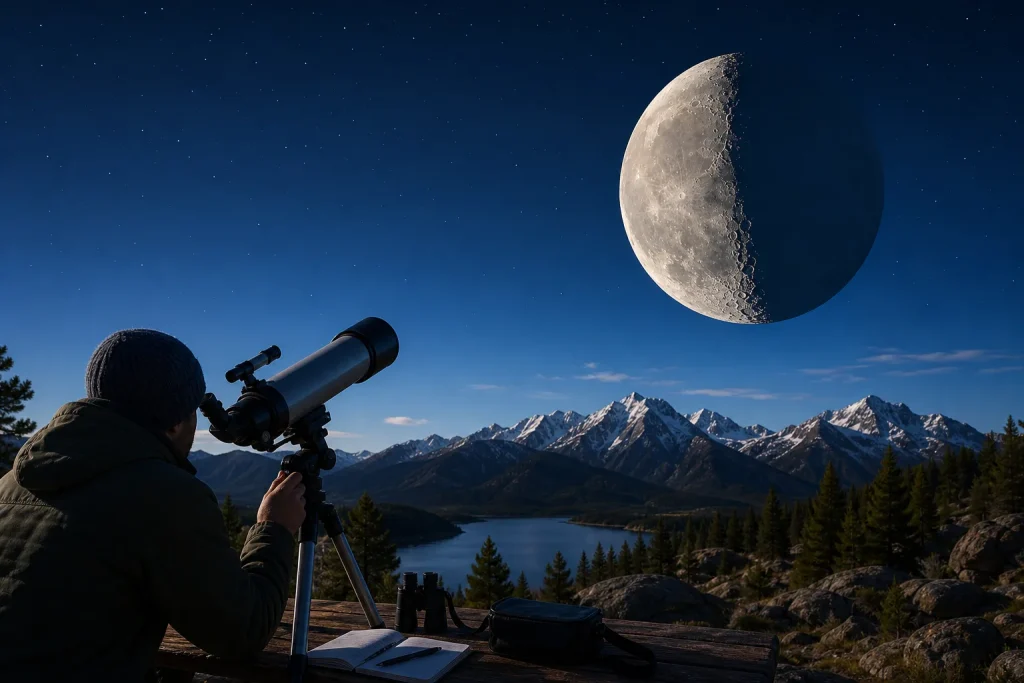
The most common mistake is expecting the Moon’s surface to look equally detailed everywhere. Near the middle of its visible face, sunlight falls more directly, so many slopes cast short shadows; the result can be a bright, pale disk that seems almost featureless. The useful exception is the terminator, the moving boundary between lunar day and night, where low-angle light stretches shadows across the ground.
The terminator is a boundary, not a permanent line
The Moon is roughly spherical, and sunlight illuminates one half of it at a time. The terminator is the curved edge between the sunlit half and the dark half. As the Moon travels through its phases, our view of that boundary shifts across the visible lunar surface.
During a waxing phase, the illuminated portion generally grows from the right side as seen from the Northern Hemisphere; during a waning phase, it generally shrinks from the right. The terminator’s position changes night by night, but it is not a shadow cast by Earth. Earth’s shadow falls across the Moon during a lunar eclipse, a separate event.
Use the phase to decide which part of the Moon will have the most pronounced shadows.
Surface relief is easiest to notice near low-angle light
Close to the terminator, the Sun appears low over the lunar horizon. A crater rim, mountain ridge, or raised patch of ground can block the light and cast a long shadow. Farther into the bright side, the same feature may cast a shorter shadow that is harder to distinguish.
This is why binoculars or a small telescope can reveal striking texture along the boundary while the central areas look comparatively smooth. The effect is especially useful for noticing crater shapes: a bright rim may curve around a dark interior, while a shadowed wall hints at the crater’s depth and slope.
Look for the pattern of light and shadow, not just the brightest details.
A flat-looking Moon usually means the light is too direct
If the Moon looks like a smooth disk, you may be observing a phase or region where sunlight falls at a steep angle. The surface is still uneven, but shadows are shorter and less conspicuous. Magnification cannot change the lighting angle that determines those shadows.
Try observing on a different evening, when the terminator crosses a feature you want to inspect. A waxing crescent or first-quarter Moon often puts a broad stretch of the boundary in view; a waning Moon can offer a different set of illuminated features and is better placed at different hours. The exact best time depends on the feature and your local sky.
Say you can see the Moon but its craters look washed out. If the terminator is far from the crater you are studying, wait for a later phase or choose a crater nearer the boundary; the expected visible change is longer shadows and clearer contrast around its rim.
Soft or shaky details often come from the observing setup
Even a well-placed terminator can look indistinct through a shaky view. Handheld binoculars magnify small movements, and a telescope that has not settled after being moved may wobble. Rest your arms on a stable surface, or use a tripod or firm mount where your equipment allows it.
Another common cause is looking through a window. Glass can soften the image and introduce reflections, while warm air near a building may shimmer in the line of sight. If practical, observe outdoors with an unobstructed view. Let your eyes settle, focus carefully, and make small adjustments rather than turning several controls at once.
If the image keeps trembling, steady the instrument before increasing magnification.
A bright glare can hide nearby detail
The Moon can feel dazzling, particularly in a dark yard or through an eyepiece with a narrow field. Glare may make it harder to see subtle differences between the bright terrain and shadow. That does not mean you need special equipment: give your eyes a little time to adjust, and avoid staring at a bright lamp immediately beforehand.
With binoculars, keep the Moon comfortably framed rather than forcing it to fill the view. With a telescope, begin at lower magnification, where focusing and tracking are often easier, then increase magnification only if the image remains steady and sharp. A neutral-density lunar filter is optional, not a requirement. If you choose one, follow the filter maker’s instructions and use only a filter specifically designed to attach at the eyepiece end; never place an unapproved filter in the optical path. Never look at the Sun through lunar observing equipment.
Orientation can make the boundary seem to move the wrong way
The Moon’s apparent orientation changes with where you observe from and how an optical instrument presents the image. Binoculars generally preserve an upright view, while some telescopes rotate or invert it. The terminator may therefore seem to run in a different direction than a map suggests.
Rather than relying on “left” and “right” alone, identify a conspicuous feature such as a large dark plain, then compare its position with a lunar map or atlas. If the view is rotated, turn the map to match what you see. This simple alignment makes it easier to keep track of which crater or ridge is near the terminator.
Clouds and poor focus can imitate missing relief
Thin cloud, haze, or moisture can lower contrast without fully hiding the Moon. If the view looks milky, check whether nearby stars are also dim or blurred and whether the Moon’s edge appears crisp. A clear gap in the clouds may offer a much better view than a long session under a veil.
For a focus problem, move the focus control slowly until the lunar edge looks sharp, then check whether small features near the terminator become more distinct. If the edge stays soft, the atmosphere may be unsteady, the optics may need attention, or the instrument may not be focused for your eyesight. Change one factor at a time so you can tell what helped.
Choose a feature and return as the light shifts
The terminator offers a natural way to follow changing light. Pick a recognizable crater or ridge near the boundary, note the Moon’s phase, and look again on another suitable evening. As sunlight reaches more of the surface, shadows can shorten or disappear; on another part of the Moon, the boundary may bring a fresh set of relief into view.
A simple observing note can record the date, phase, instrument, and feature you watched. It need not be elaborate: the purpose is to remember where the terminator lay and how the shadows appeared. With that reference, a later view becomes easier to compare, and the moving border of light becomes a useful guide.
Nearby in the sky
When the Sky Is Bright: Observing Through Urban Light
Bright city skies hide faint stars, but the Moon, planets, and familiar constellations can still make…
A Telescope’s Aperture, Explained by the Light It Gathers
Aperture describes the opening that gathers light, but it does not predict every view. Learn how…