What a Meteor Shower Actually Leaves Behind
Meteor showers seem to stream from one patch of sky, but that apparent source is a perspective effect. The flash is a brief atmospheric event, and any lingering train is not a solid trail waiting to fall.
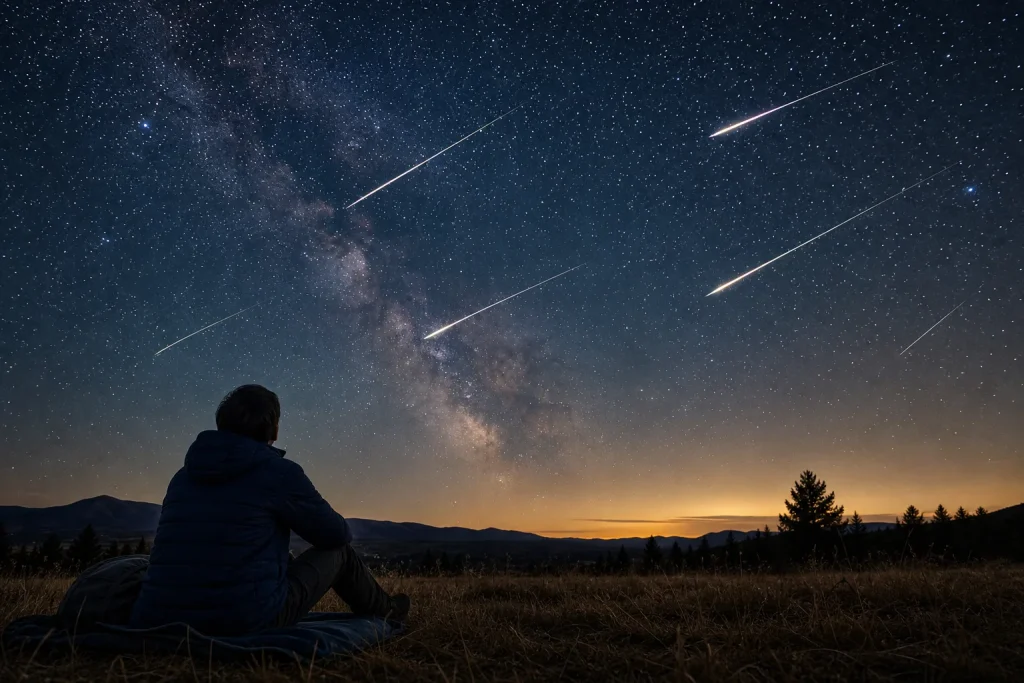
The common mistake is to picture a meteor shower as glowing rocks flying outward from one point in the sky. That can make the radiant seem like a real source and the streaks like solid trails suspended overhead. The radiant is a viewing direction, while the flash is light produced during a particle’s passage through the atmosphere.
The radiant marks an apparent direction
A shower’s radiant is the part of the sky from which its meteors appear to spread. Its name often comes from a constellation near that point, but the constellation is not where the particles originate.
The effect resembles looking down a straight road: parallel edges seem to meet at the horizon even though they remain apart. Shower particles travel on related paths, and their tracks appear to converge because an observer sees them from Earth.
Several tracks that seem to point back toward the same region can help identify a shower. The radiant is a directional clue, not a target to stare at.
The flash is an atmospheric event
The visible streak appears when a small object from space enters Earth’s atmosphere at high speed and interacts with the surrounding air. The technical name for the event is a meteor; the object traveling through space is a meteoroid.
The light is brief. It does not mean a glowing stone is cruising across the sky, nor does it reveal the object’s full route through space.
A bright flash may look dramatic even when the particle is small. Brightness alone does not tell you whether material will reach the ground.
A lingering train is not a solid trail
Most meteor streaks vanish from view quickly. Some bright meteors leave a persistent train, a faint luminous trace that can remain visible after the flash and change shape as air moves high in the atmosphere.
That trace is an atmospheric effect, not a string of debris suspended in the sky. If it fades or shifts, you are seeing the trace change, not a solid object drifting overhead.
If a fragment survives the passage and reaches the ground, it is called a meteorite. A flash by itself is not evidence that a meteorite landed.
Earth passes through a spread of particles
A meteor shower occurs when Earth moves through a stream of small particles spread along related orbits. Each visible meteor comes from a separate encounter with a particle; the streaks do not shoot out of the radiant.
Many streams are associated with material shed by comets, while some are linked to other kinds of bodies. The details differ among showers, but the apparent pattern comes from the particles’ paths and the observer’s position on Earth.
Say you are watching from a dark field and notice three streaks crossing different parts of the sky. If you extend their paths backward and they seem to meet near the shower’s radiant, that supports identifying them with the same shower. It does not mean they began at that point; the convergence is a perspective effect.
Look across the sky, not only at the radiant
Meteors from a shower can appear far from its radiant. Their paths, if extended backward, point toward that region, but observers do not need to watch the radiant itself.
Choose an open, comfortable view of the sky and let your eyes take in a broad area. If you want to check a meteor’s direction afterward, note where it appeared and which way it crossed, then compare that path with the radiant.
Keep the three terms distinct: a meteoroid travels through space, a meteor is the atmospheric light event, and a meteorite is surviving material that reaches the ground. What remains after an ordinary meteor is usually a memory of the flash, not a glowing line or a recoverable object.
Nearby in the sky
When the Sky Is Bright: Observing Through Urban Light
Bright city skies hide faint stars, but the Moon, planets, and familiar constellations can still make…
A Telescope’s Aperture, Explained by the Light It Gathers
Aperture describes the opening that gathers light, but it does not predict every view. Learn how…