When the Sky Is Bright: Observing Through Urban Light
Bright city skies hide faint stars, but the Moon, planets, and familiar constellations can still make an evening outside rewarding. Learn how to choose targets, read a chart, and adapt when glare or haze limits the view.
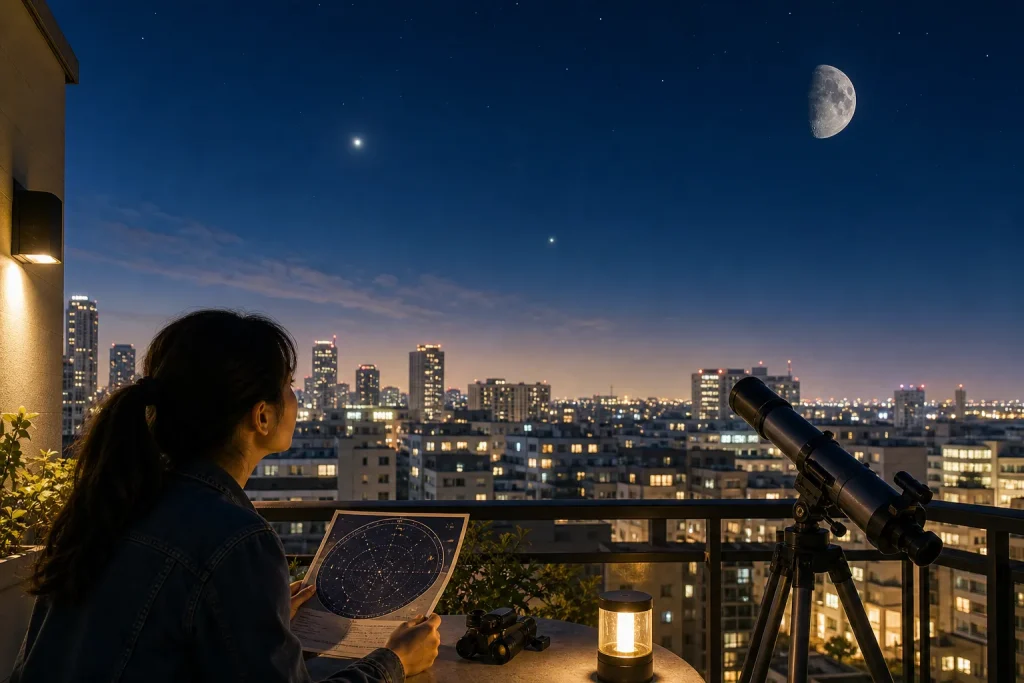
The most common mistake under a bright city sky is to search for a faint, crowded star field and judge the whole night by what is missing. Streetlights and illuminated buildings wash out dim stars first, so familiar constellations can look sparse and galaxies may be invisible; expecting them to resemble views from a dark site can make a good evening frustrating. Choose targets that stand out against the glow instead.
Choose targets that suit a bright sky
Before heading out, check which planets are above the horizon and what phase the Moon is in. Venus, Jupiter, or Saturn can appear as bright points against a city sky, depending on their positions and the time of year. Use a current sky chart or astronomy app rather than assuming a particular planet will be visible.
The Moon is another compelling subject, and its changing shape offers a clear point of comparison from one evening to another. A crescent or half-lit Moon shows a distinct boundary between day and night; a full Moon is bright enough to make nearby stars harder to pick out. If the Moon is up, observe it as a destination rather than treating it as an obstacle.
Bright stars and simple asterisms—the recognizable patterns within or across constellations—also work well. The Big Dipper, for example, may remain recognizable when its fainter surrounding stars are lost. Some double stars are visible without magnification, but only when both stars are bright enough and sufficiently separated; a star chart can help identify suitable pairs.
Save faint galaxies, nebulae, and dense star clusters for a darker site or another night. The point is to match the target to the contrast the sky allows.
Choose a safe spot with a clear view
Look for a place with an unobstructed view and no direct light shining into your eyes. A courtyard, rooftop, or quiet park may offer a better outlook than a sidewalk beneath a bright lamp, but use only places where you are allowed to be and can stand safely. A wall or building that blocks a nearby lamp can improve comfort, though it will not remove the broader city glow.
Notice which part of the sky is brightest and where rooftops or trees block the view. When buildings hide the horizon, choose targets higher above them; haze and dust often make objects near the horizon harder to see. Keep nearby lamps out of your direct line of sight where you can do so without moving into an unsafe or unauthorized area.
Check the sky chart against the view from your chosen spot. If a roof blocks the planet you planned to see, select another target in an open part of the sky rather than repeatedly searching behind the obstruction.
Use a chart to find bright objects
Choose a current sky map set for your location and time. A printed planisphere shows the general arrangement of stars, while an astronomy app can identify planets and the Moon. Set the app’s location and time correctly; if its map does not match the sky, check those settings before changing your search.
Start with a bright landmark you can identify, then follow a short chain of stars toward your target. Match a constellation’s overall shape before looking for its fainter members. Under urban glow, some stars shown on the chart may be invisible, so use the brightest ones as anchors and accept that the full pattern may not appear.
Say you step onto a balcony and want to locate Jupiter. Your chart shows it near a bright star, so you first find that star and then compare the nearby points of light with the chart. If one bright point sits where the chart predicts and shows less obvious twinkling than the nearby stars, Jupiter is a plausible identification, not a certainty; if the positions do not line up, check the time, direction, and balcony’s view before deciding it is hidden.
Read apparent steadiness with care
Stars are so distant that they appear as points to the unaided eye. A planet’s apparent disk is broader, so atmospheric turbulence may affect its light differently, and it can look steadier than a star. This is a rule of thumb, not a reliable identification test: planets can shimmer too, and brightness, altitude, haze, and atmospheric conditions all affect what you see.
If a bright object flickers or changes color, the atmosphere may be disturbing its light, especially when it is low in the sky. When possible, compare it with a target higher above the horizon, where its light passes through less atmosphere. Use a chart to confirm an object’s identity rather than relying on steadiness alone.
With the Moon, notice the outline of its lit portion and the contrast near the boundary between light and shadow. With a constellation, trace the brightest stars that form its recognizable shape. A few clearly placed stars can be enough to identify a pattern.
Switch targets when conditions get in the way
If a target does not appear after a careful search, check the chart’s direction against the actual horizon. A roof may block it, the object may have set, or thin clouds may be dulling the view. If the target is obstructed or obscured, choose a brighter object in a clear part of the sky; if the chart and view disagree, verify the time and location settings before trying again.
- Check whether the target is above the horizon; if it has set or has not risen, choose a target listed as visible instead.
- Check whether a roof or tree blocks the target’s direction; if the view is obstructed, move only to a safe, permitted spot with a clear opening, or select another target.
- Look for thin cloud across the target; if its light is blurred or dimmed, wait for a clear opening or switch to an unobscured part of the sky.
- Check whether a nearby lamp shines directly into your eyes; if it does, reposition safely or choose a different viewing direction, and leave if neither option is safe.
- Compare the chart’s location and time with your actual location and clock; if either is wrong, correct it before searching again.
- Assess whether the Moon is bright near a faint target; if it is, turn to the Moon, a bright planet, or a prominent constellation rather than persisting with the faint object.
Imagine you have a hypothetical evening on a balcony, a chart set to the correct location and time, and a low roof blocking the planet marked near the western horizon. You check the roofline, confirm the planet’s direction, and see that the roof covers that part of the sky; you then choose a bright star pattern in an open section instead. The resulting decision is to stop searching for the blocked planet and spend the session identifying stars that are actually visible.
Before you go inside, note one bright object’s direction and its position relative to a roofline or tree. That reference makes it easier to recognize how the sky has shifted when you look again.
Nearby in the sky
A Telescope’s Aperture, Explained by the Light It Gathers
Aperture describes the opening that gathers light, but it does not predict every view. Learn how…
What a Meteor Shower Actually Leaves Behind
Meteor showers seem to stream from one patch of sky, but that apparent source is a…